



GoldenLeaf Sports14+ Years Teamwear Manufacturer · Shenzhen, China
GoldenLeaf Sports14+ Years Teamwear Manufacturer · Shenzhen, China
Choosing the best Lacrosse Uniforms made in China requires more than comparing prices. A strong uniform must survive hard checks, repeated washing, and long summer tournaments. China has experienced manufacturers with advanced sublimation printing, moisture-wicking fabrics, flatlock stitching, and flexible customization. However, factory capability differs widely. A polished sample does not always prove consistent production.
Lacrosse educator and former professional player Kyle Harrison has said, “Lacrosse is a game of speed, skill, and toughness.” That idea also guides uniform selection. Players need lightweight fabric that moves freely during dodges and defensive slides. A durable collar should keep its shape after contact. Reinforced seams matter around the shoulders, underarms, and side panels. Clear size charts are equally important, especially for youth teams with different body shapes.
This article examines which Chinese-made Lacrosse Uniforms offer the strongest balance of comfort, durability, design, and value. It considers fabric weight, colorfastness, stitching quality, breathability, and production consistency. It also reviews supplier communication, sample approval, packaging, and quality inspections. Responsible buyers should request fabric specifications and wash-test results. They should also confirm ethical manufacturing practices and applicable safety requirements.
I would not claim that the cheapest option is the best. That assumption often fails after several washes. A minor printing flaw may seem harmless, yet uneven sizing can disrupt an entire team. The final choice should reflect real game conditions, not only attractive product photos.
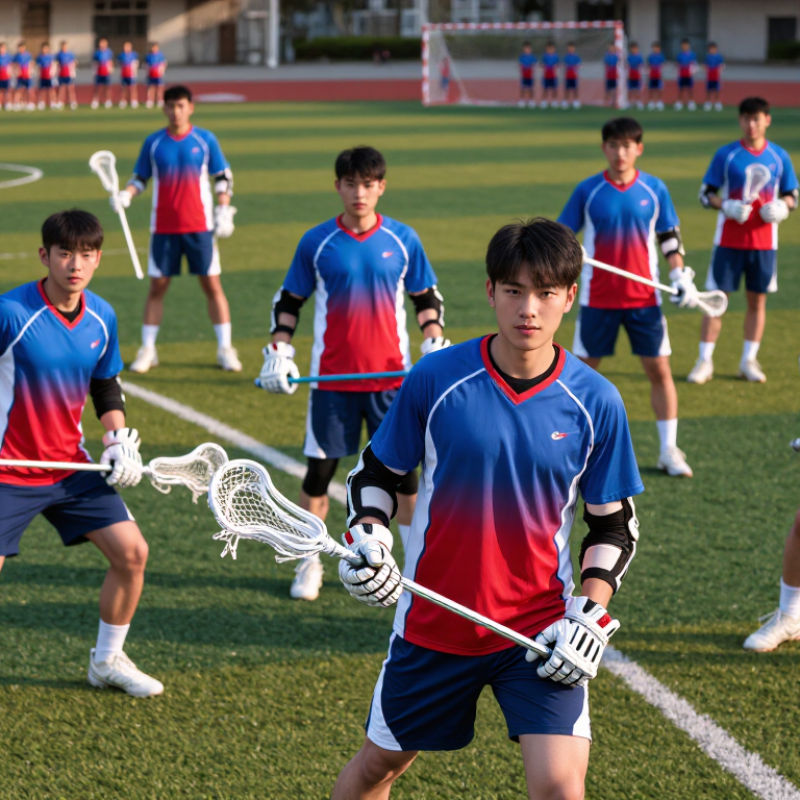
Lacrosse Uniforms Made in China: Materials, Design, and Production
Quality lacrosse uniforms made in China begin with fabric selection, not decoration. The 2024 Textile Exchange Materials Market Report estimates global fiber production reached 124 million tonnes in 2023. Polyester represented about 57% of that volume. This explains its popularity in lightweight, quick-drying uniforms. A strong fabric should resist snagging, keep color after washing, and allow airflow through mesh panels. Recycled polyester can reduce virgin-material use, although it does not automatically guarantee better performance.
Design needs to follow movement. A player bends, rotates, and accelerates repeatedly. Flat seams can reduce rubbing around the shoulders and underarms. A carefully shaped sleeve also supports stick control. During sampling, I would check the collar, sleeve opening, and waistband after repeated stretching. Small fit problems become obvious on the field. The testing plan should include colorfastness, dimensional change, and seam strength. AATCC and ISO textile test methods provide useful reference points. Still, laboratory results cannot replace a real practice session. That is where some designs fail.
Tips: Request a physical sample before bulk production. Test it after several washes. Measure shrinkage and compare the actual fabric weight with the specification. Ask for color approval under daylight, because indoor lighting can hide unwanted shades. Digital artwork may look sharp, yet embroidery or heat-transfer details can affect breathability. Leave room for revision; the first sample is rarely perfect.
The following comparison summarizes practical specifications commonly used when evaluating custom lacrosse uniforms manufactured in China. Actual performance depends on the selected fabric, construction method, artwork, quality controls, and order requirements.
| Evaluation Dimension | Recommended Specification | Why It Matters for Lacrosse | Typical Production Considerations |
|---|---|---|---|
| Primary Fabric | 100% polyester performance mesh or a polyester interlock knit | Polyester is lightweight, dries quickly, resists shrinking, and holds printed graphics well. | Mesh improves airflow, while interlock provides a smoother surface and a more structured appearance. |
| Fabric Weight | Approximately 130–180 g/m² for most field jerseys | A moderate fabric weight balances breathability, durability, and player comfort during active play. | Heavier fabrics may improve opacity and structure but can increase heat retention and garment weight. |
| Stretch Performance | Two-way or four-way stretch, depending on the fabric construction | Stretch helps players move their shoulders, arms, and torso without excessive garment restriction. | Stretch should be tested after printing and washing because some finishing processes can affect recovery. |
| Moisture Management | Moisture-wicking polyester with breathable knit zones | Wicking construction helps move perspiration away from the skin and supports faster evaporation. | Performance claims should be verified with fabric test reports rather than relying only on marketing descriptions. |
| Decoration Method | Sublimation for all-over graphics; heat transfer or embroidery for selected details | Sublimation integrates artwork into polyester fibers and avoids the heavy feel of large surface prints. | Sublimation is best suited to polyester garments and requires accurate color files and controlled heat settings. |
| Color Fastness | Color testing after repeated washing, rubbing, and perspiration exposure | Strong color fastness helps preserve team colors and reduces the risk of bleeding onto light sections. | Final results depend on the dye system, fabric composition, curing process, detergent, and washing conditions. |
| Seam Construction | Reinforced shoulder seams, secure side seams, and covered or flat seams where appropriate | Reinforcement reduces seam failure during contact, stretching, and repeated laundering. | High-stress areas should receive extra inspection for skipped stitches, loose threads, and uneven seam allowance. |
| Neckline and Armholes | Flexible rib-knit or self-fabric binding with comfortable armhole shaping | A well-finished neckline and armhole reduce chafing while allowing full upper-body movement. | Measurements should be checked against an approved sample because small pattern changes can affect mobility and fit. |
| Fit Options | Regular, athletic, and relaxed cuts with a graded size chart | Different cuts accommodate player preference, protective equipment, and layering requirements. | A size-set sample is recommended to confirm chest width, body length, sleeve opening, and tolerance limits. |
| Number and Name Application | Digitally printed, sublimated, or heat-applied numbers with clear contrast | Readable identification supports officials, teammates, spectators, and tournament administration. | Artwork should define number dimensions, placement, font style, contrast, and acceptable alignment tolerance. |
| Sizing Range | Children’s through adult sizes, based on a measurement chart rather than age alone | Chest, waist, body length, and shoulder measurements provide more reliable fit information than generic labels. | Manufacturers should provide finished-garment measurements and a tolerance range for production approval. |
| Prototype and Approval | Digital artwork approval followed by a physical pre-production sample | A physical sample verifies color placement, fit, fabric hand feel, trims, and construction before bulk production. | Bulk manufacturing should begin only after written approval of the final sample and specification sheet. |
| Quality Inspection | Inspection of measurements, stitching, printing, labels, packaging, and random finished units | Documented inspection reduces defects such as incorrect sizes, misplaced graphics, loose threads, and color variation. | Inspection criteria should be agreed in advance, including acceptable defect limits and corrective-action procedures. |
| Typical Production Timeline | Sample development commonly takes about 7–15 working days; bulk production often takes about 20–35 working days after approval | Allowing time for sampling and quality checks helps avoid rushed production before a competition or season. | Timelines vary with order quantity, artwork complexity, fabric availability, revisions, and holiday periods. |
| Minimum Order Planning | Confirm minimum quantities separately for each design, colorway, and size mix | Order structure affects unit cost, production efficiency, and the ability to combine player sizes. | Small orders may have higher unit costs, while large orders require careful size forecasting and inventory planning. |
| Labels and Packaging | Printed care label, size label, team identification label, and individual protective packaging | Clear labeling supports correct distribution, care, traceability, and organized team delivery. | Label content should include fiber composition and care instructions appropriate for the destination market. |
| Care Requirements | Cold or warm machine wash, inside out; avoid chlorine bleach and high-heat tumble drying | Lower heat and mild washing help preserve polyester performance fabrics, prints, and color clarity. | Care instructions should be tested on the finished garment because decoration and fabric combinations vary. |
| Best Overall Selection Criteria | Balanced fabric performance, accurate sizing, durable seams, clear graphics, and documented quality control | The best uniform is not defined by appearance alone; comfort, durability, consistency, and fit are equally important. | A complete technical specification and approved sample provide the strongest basis for comparing production options. |
Note: Specifications are general industry planning ranges, not guarantees for every order. Buyers should confirm final fabric composition, test results, measurements, production schedule, and inspection requirements in writing before manufacturing.
Lightweight polyester is common because it dries quickly and supports airflow. Mesh panels can improve ventilation during long practices. Recycled polyester may reduce virgin-material use, but it does not guarantee better performance. Comfort matters.
Check the collar, sleeve openings, waistband, seams, and fabric weight. Stretch the garment repeatedly and look for tight areas or loose threads. A real practice session can reveal problems that photographs miss.
Wash the sample several times according to the care instructions. Inspect fading, shrinkage, seam damage, and dimensional changes. Also check whether the fabric still recovers after stretching. Laboratory results help, but field testing remains necessary.
Sublimation can place detailed patterns inside the fabric. It usually avoids peeling from surface printing. Embroidery may suit small details, but it can add weight and reduce comfort. Decoration affects breathability.
Request a measurement chart before ordering. Compare chest, shoulder, sleeve, and body measurements with a well-fitting garment. A physical sample can reveal tight armholes or an overly long jersey. Standard sizing is not always reliable.
Flat seams may reduce rubbing around the shoulders and underarms. Reinforced side and shoulder seams can reduce tearing during contact. Proper sleeve length supports stick control without restricting the arms. Small fit problems matter.
Ask for fabric, decoration, stitching, packaging, sample fees, shipping, and setup charges. Confirm minimum order quantities in writing. A lower unit price may create unwanted stock if the order is too large.
Approve production only after checking a physical sample and size set. Compare actual measurements with the approved chart. Confirm colors under daylight, because indoor lighting can hide unwanted shades. My first sample was not perfect. Revision is normal.
The best Lacrosse Uniforms made in China combine durable, breathable materials with functional designs suited to fast-paced play. High-quality options typically use lightweight performance fabrics that support moisture management, comfort, flexibility, and long-term wear. Careful stitching, reinforced seams, reliable closures, accurate printing, and consistent sizing are also important indicators of quality. Buyers should compare manufacturers by reviewing their production capabilities, customization services, sample quality, communication, lead times, and experience with international orders.
Customization may include colors, patterns, player names, numbers, logos, collar styles, and coordinated team accessories. Before placing an order, teams should confirm size charts, sample approval procedures, pricing, minimum order quantities, and payment terms. Reliable manufacturers should maintain clear quality-control processes, use safe and compliant materials, inspect finished products, and provide secure packaging for international shipping. By evaluating these factors together, buyers can select uniforms that offer a practical balance of performance, appearance, durability, cost, and dependable delivery.
