
GoldenLeaf Sports14+ Years Teamwear Manufacturer · Shenzhen, China

How to Choose Football Uniforms for Your Team?

Time:2026-11-18 Author:Sophia
0%

Choosing Football Uniforms is more than selecting colors and adding a team name. The right kit must fit real players, hold up through contact and repeated washing, and remain comfortable under pads in changing weather. Small details matter: sleeve length, reinforced seams, stretch panels, and numbers that stay readable from the sideline. There is no perfect uniform for every roster.

The scale of participation makes thoughtful choices worthwhile. The National Federation of State High School Associations’ 2023–24 High School Athletics Participation Survey counted 1,028,761 boys in 11-player football. That figure is not a uniform-sizing study. Still, it reflects how many athletes depend on practical, well-fitting team gear. Coaches and equipment managers should compare sizing charts with actual measurements, request fabric and care details, and check samples before placing a large order. Players should be able to raise their arms, bend, and move at game speed without constant pulling or pinching. Comfort is easy to overlook.

This guide explains how to assess fit, fabric, durability, customization, and cost. It also distinguishes uniform features from certified protective equipment: jerseys and pants do not replace properly fitted helmets or pads. Ask suppliers clear questions, and keep written specifications for colors, numbers, and delivery dates. A sample can still differ from the finished batch, so inspect it carefully. That extra check may prevent an expensive surprise.
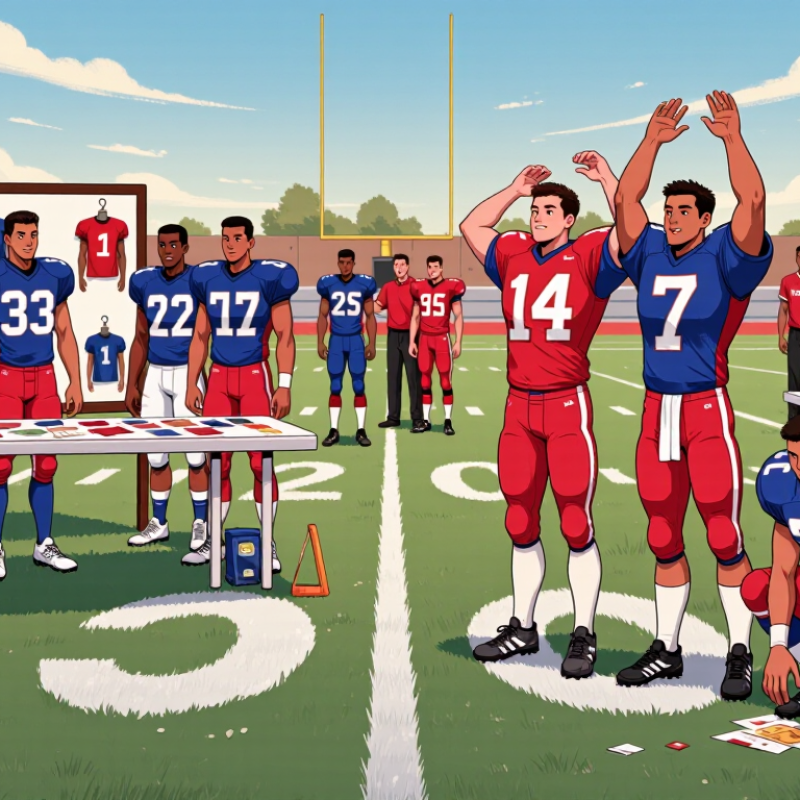
How to Choose Football Uniforms for Your Team?

Check league rules and NFHS jersey-number requirements (0–99)

Before ordering football uniforms, read your league’s current rulebook and confirm which NFHS rules your competition follows. NFHS numbering permits jersey numbers from 0 through 99, but that range is only a starting point. Local leagues, state associations, or tournament rules may add restrictions. Ask the athletic director or officials to confirm acceptable numbers, placement, and contrast before approving artwork.

Numbers also affect player eligibility under NFHS rules. For example, players wearing numbers 50–79 are generally ineligible to catch a forward pass, with specific rule-based exceptions. Check your team’s positions and roster before assigning numbers. A number that looks clear on a spreadsheet may create confusion on the field if players change roles. I would not leave this check until uniforms arrive; correcting sewn numbers can cost time and money.

Tips: Request written confirmation of the applicable rules. Keep a roster showing each player’s number and position, then compare it with the final order. Check samples under stadium lighting, too. Small details matter. Don’t assume last season’s rules still apply.

Measure every player to match jerseys with pads and body dimensions

A reliable football uniform fit starts with the player wearing the pads they will use on game day. Measure chest circumference over the shoulder pads, keeping the tape level and snug without compressing the padding. Record the player’s height and weight too, but treat them as supporting details, not substitutes for measurements. Pads change the fit more than many teams expect.

Check shoulder width and jersey length during a try-on. The shoulder seams should sit near the edge of the pads, while the hem should cover the waistband without restricting movement. Ask each player to raise both arms, reach forward, and bend into a stance. Watch for pulling across the chest, exposed midriff, or sleeves that catch on the pads. Small details matter.

Use the uniform maker’s size chart, since sizing can vary between suppliers. Keep a private measurement record for each player, including the date and pad configuration. A jersey that fits over one set of pads may feel tight over another. Avoid sizing up automatically; excess fabric can bunch or shift during play. A chart can still miss. Recheck unusual fits before placing the full team order, and leave enough time for adjustments.

How to Choose Football Uniforms for Your Team

Compare each player’s chest measurement with and without shoulder pads to help select a jersey size that accommodates playing equipment.

Illustrative measurements for a 12-player sample, in inches. Measure the chest over the shoulder pads the player will wear during games, then check the uniform size chart. Pad bulk and jersey cuts vary, so measure every player individually.

Compare moisture-wicking fabrics using AATCC TM195 test results

For a football uniform, moisture-wicking claims need numbers behind them. Ask for a laboratory report using AATCC TM195, which measures liquid moisture movement across fabric. Compare wetting time, absorption rate, spreading speed, and overall moisture management capacity (OMMC). AATCC TM195’s OMMC bands classify 0.6–0.8 as “very good” and 0.8–1.0 as “excellent.” These ranges make reports easier to read, but they are not guarantees of comfort during a full match. Check whether the tested fabric matches the proposed uniform’s knit, weight, and finish.

Compare fabrics tested under the same conditions. A report showing an OMMC of 0.82 may look stronger than one at 0.68, yet the gap matters less if sweat spreads slowly on the skin-facing side. Look closely at the top and bottom spreading results. A broad, even wet patch can help disperse sweat; a damp, clingy chest panel is less convincing. Ask for replicate results, not just a single best reading. Also request data after washing, since finishes can change. The test is useful. It cannot recreate a humid evening, shoulder pads, or repeated tackles, so treat lab numbers as evidence—not the whole decision.

Assess fabric durability with ASTM D5034 tensile-strength data

How to Choose Football Uniforms for Your Team?
Assess fabric durability with ASTM D5034 tensile-strength data

When comparing football uniform fabrics, look beyond weight and feel. ASTM D5034, commonly called the grab test, measures the force needed to rupture a fabric specimen held in a testing machine. Ask suppliers for reports showing results in newtons or pounds-force, along with fabric direction and test conditions. Higher tensile strength may indicate better resistance to pulling, but it does not guarantee a longer-lasting uniform. Not the whole story. Turf abrasion, washing, seams, and fit also affect wear.

Tips: Compare results only when labs used the same method and comparable conditioning. Test both fabric directions. Request several specimens, not one unusually strong sample. Keep notes on the fabric lot and report date.

Use tensile data as one part of a practical review. A jersey can have strong fabric yet fail at a seam under repeated strain. Inspect stitching and stress points around shoulders, numbers, and reinforced panels. If possible, wear and wash samples through several practice sessions, then check for thinning, snags, or opening seams. Be cautious of claims unsupported by a test report. ASTM D5034 does not set one ideal score for every team. Choose fabric suited to your schedule, level of contact, and replacement budget. Real wear can surprise you.

Confirm team colors, number contrast, and full-kit compliance before ordering

Before ordering, lock the team’s approved colors and check them on the actual fabric, not just a screen. Navy can look almost black under stadium lights. Ask for a physical swatch, then compare it with the helmet, pants, and socks in daylight and under field lighting. The NFHS 2023–24 High School Athletics Participation Survey counted 1,028,761 boys playing 11-player football. For teams ordering at scale, a written color standard can help prevent mismatched replacement pieces.

Number contrast deserves its own check. Test the smallest number on the darkest jersey from the stands, not only on a close-up proof. NCAA football rules specify uniform-number requirements, while school and league rules may add details. Check the current governing-body rulebook for number placement, size, and permitted markings. A polished mock-up can still fail inspection if a sleeve detail or alternate jersey breaks a local rule. This is easy to miss.

Tips: Put every item on one checklist: home and away jerseys, pants, socks, helmet decals, and any warm-up pieces covered by team rules. Compare the full kit with the current rulebook before approving production. Record sizes and color codes for later reorders. I would not treat a digital proof as final; fabric and lighting can change the result.

FAQS

What does a moisture-management test measure?

It measures how liquid moves through fabric, including wetting time, absorption, spreading, and overall moisture management.

What does an OMMC score mean?

Scores from 0.6 to 0.8 are rated very good; 0.8 to 1.0 are excellent. They do not guarantee comfort.

How should I compare moisture-wicking test reports?

Compare fabrics tested under the same conditions. Check both fabric surfaces and look for broad, even spreading.

Why request results after washing?

Washing can change fabric finishes and performance. Ask for repeated readings, not only one best result.

Can laboratory results predict comfort during a game?

Not completely. Humid weather, shoulder pads, and repeated contact can change how a uniform feels.

What does a tensile-strength test tell me?

It measures the force needed to rupture a fabric sample. Higher results may suggest better resistance to pulling.

Does strong fabric mean a uniform will last longer?

Not always. Seams, turf abrasion, washing, and fit also affect wear. Not the whole story.

What should I inspect on a uniform sample?

Check stitching near shoulders, numbers, and reinforced panels. Wear and wash samples through several practices, then look for snags or thinning.

Is one test result enough to choose a fabric?

I would not rely on one unusually strong sample. Compare several specimens, both fabric directions, and the report conditions.

Conclusion

Choosing Football Uniforms starts with confirming that every design meets league rules and NFHS jersey-number requirements, including the permitted 0–99 range. Next, measure each player while accounting for shoulder pads and individual body dimensions, so jerseys provide a comfortable fit without restricting movement. Rather than judging fabric by feel alone, compare moisture-management performance using available AATCC TM195 test results, and review ASTM D5034 tensile-strength data to assess resistance to pulling and wear. Before placing an order, verify that team colors are consistent, numbers contrast clearly with the jersey background, and every part of the proposed kit meets applicable requirements. A careful review of fit, performance, durability, and compliance can help a team select uniforms that are practical for players and ready for the season.

Sophia

Sophia

Sophia is a dedicated marketing professional with an exceptional depth of knowledge about her company's products and services. With a keen understanding of market trends and customer needs, she crafts insightful blog posts that not only inform but also engage readers, enriching the company’s online......