GoldenLeaf Sports14+ Years Teamwear Manufacturer · Shenzhen, China
GoldenLeaf Sports14+ Years Teamwear Manufacturer · Shenzhen, China
Rugby is fundamentally one of the most physically demanding collision sports on earth. Apparel designed for year-round competition must survive extreme kinetic stress—high-tensile dragging, scrums, tackles, mud immersion, and harsh thermal shifts—without tearing, retaining water, or restricting player velocity.
Historically dominated by 100% heavy cotton weaves (300+ GSM), modern elite rugby apparel manufactured in specialized hubs like China has completely transitioned into synthetic macro-polymer engineering. The question "China is it what are the best materials for all-season rugby apparel?" is no longer answered by choosing a single cloth, but by deploying hybrid, zoned material architectures.
At GoldenLeaf Sports (ShenZhen) Co., Ltd. (operating a 3,000 m² facility with 160+ skilled technicians), our research demonstrates that true all-season performance relies on precise synthetic blends combining high-denier polyester interlock, elastane matrix structures, and weather-defying hydrophobic treatments.
All-season rugby wear requires adaptation across scorching summer 7s tournaments to ice-bound, wet winter 15s matches. OEM manufacturers in China categorize raw material engineering into four core pillars:
Best For: Professional Match Jerseys (Winter/Autumn) & High-Tackle Contact Training.
Technical DNA: Engineered with 88% High-Tenacity Polyester and 12% Spandex. The high GSM ensures tensile resistance exceeding 350 N along warp and weft threads, making it virtually un-grabable during tackles while offering 4-way stretch rebound.
Best For: Summer Rugby 7s, Touch Rugby & Side Ventilation Panels.
Technical DNA: Utilizes 100% moisture-wicking micro-polyester yarn with a hydrophilic finish. Capable of capillary water transport that evaporates sweat 3x faster than traditional cotton, maintaining structural light-weighting under intense humidity.
Best For: Professional Rugby Shorts & Scrimmage Bibs.
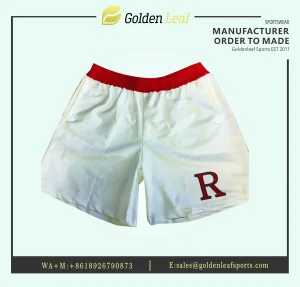
Technical DNA: Features a grid-woven structure with integrated reinforcement threads. Shorts made with poly-twill resist ground friction during scrums and rucks, while elastane gusset inserts allow full hip abduction during kicking.
| Fabric Material Spec | GSM Range | Composition | Tensile Strength | Thermal / Season Fit | Primary Application |
|---|---|---|---|---|---|
| Pro-Fit Elastane Interlock | 280 - 320 gsm | 88% Poly / 12% Spandex | Extreme (>350 N) | All-Season / Cold Wet | Elite Pro Match Kits |
| Breathable Bird-Eye Mesh | 150 - 180 gsm | 100% Hydrophilic Poly | Moderate (180 N) | Hot Summer / Indoor | Rugby 7s & Training Tees |
| Rugby Ripstop Twill | 240 - 270 gsm | 95% Poly / 5% Elastane | High (>300 N) | All-Season Ground Friction | Match Shorts & Shells |
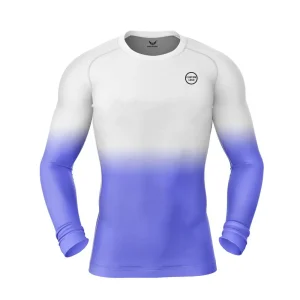
| Thermal Brushed Base Layer | 200 - 240 gsm | 85% Poly / 15% Elastane | High Elasticity | Sub-Zero Winter Play | Compression Undergarments |
The global rugby apparel market is currently undergoing a massive structural shift toward full digital sublimation, sustainable recycled synthetic polymers, and direct-to-factory custom supply chains.
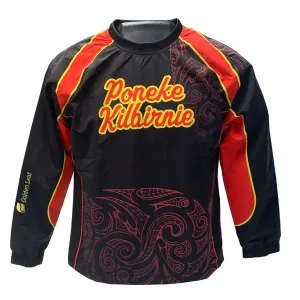
Traditionally concentrated in Oceania, Western Europe, and South Africa, rugby participation is exploding across North America (MLR growth) and Asia-Pacific. Brands no longer rely on static inventory models. Modern procurement officers demand Low MOQ (10-piece runs) with rapid turnaround (12-18 days), enabling clubs to print individualized player names, numbers, and multiple sponsor logos across a single batch without tooling surcharges.
China remains the undisputed global engine for technical sportswear export. Advanced manufacturing centers like Shenzhen combine localized raw-material knitting mills with high-precision digital sublimation tech. By utilizing imported eco-friendly sublimation inks (Grade 4+ fastness), factories like GoldenLeaf Sports deliver garments where graphics are deeply fused into the polymer fibers, guaranteeing zero peeling or cracking under brutal tackle conditions.
Rugby is played across vastly differing micro-climates. Material specifications must adapt strictly to regional demands:
Requires 300 GSM Poly-Spandex with DWR (Durable Water Repellent) hydrophobic outer layer. Keeps players dry from pitch mud and freezing rain while maintaining inner body warmth.
Demands 180 GSM micro-perforated Cool-Max polyesters with UV 50+ blocking protection to reflect solar radiation and accelerate core temperature reduction during heatwave fixtures.
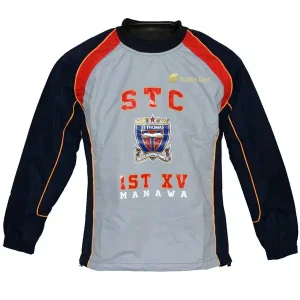
Calls for modular 3-piece kit systems: Light match jersey, thermal compression base layers, and weather-proof sideline shell jackets.
Transitioning 100% of raw polyester to post-consumer ocean plastics and recycled polyethylene yarn without sacrificing tensile bursting strength (>700 kPa).
Replacing traditional double-needle stitching with laser-cut thermal welding. Eliminates seam friction entirely and reduces kit weight by 15%.
As a turnkey OEM/ODM custom teamwear factory established in 2011, GoldenLeaf Sports solves complex international supply chain friction for brands, importers, and sports associations.
From RIP digital color management to automated laser panel cutting, heat-press transfer, and flatlock sewing—everything is operated under one roof in Longgang District, Shenzhen.
5 dedicated quality inspectors audit raw fabric density, color matching against Pantone books, seam tension stress, and garment dimensional accuracy prior to poly-bagging.
Support 10-piece minimum runs per style. Virtual artwork mock-ups delivered within 24-48 hours; full bulk order dispatch achieved in 12-18 business days.
Direct technical answers provided by our senior apparel engineering team for global brand managers and procurement specialists.