GoldenLeaf Sports14+ Years Teamwear Manufacturer · Shenzhen, China
GoldenLeaf Sports14+ Years Teamwear Manufacturer · Shenzhen, China
Explore our core engineering catalog engineered in China's leading digital sublimation manufacturing hubs. All garments feature high-tensile stitching, eco-friendly disperse inks, and customizable team branding.
Market Projections, Supply Chain Clustering, and Paradigm Shifts in Teamwear Sourcing
The international market for sublimated rugby teamwear has experienced a structural metamorphosis over the past decade. Traditionally reliant on heavy, water-absorbent knitted cotton-polyester blends with screen-printed graphics that cracked under physical tension, professional rugby clubs, university athletic departments, and retail activewear brands have overwhelmingly shifted toward high-performance full-digital dye-sublimated long sleeve rugby shirts. China has emerged as the global epicenter for this specialized manufacturing sector, leveraging advanced textile machinery, sophisticated vector color management, and vertically integrated supply chains.
Global demand for customized sublimated sports uniforms is projected to expand at a compound annual growth rate (CAGR) of 8.4% through 2032. Long sleeve rugby shirts represent a unique dual-demand segment—serving high-impact athletic competition during winter months while capturing substantial market share in global lifestyle retro-athleisure streetwear.
Sourcing centers in Guangdong Province (Shenzhen, Dongguan, Guangzhou) combine raw fabric milling, digital printing paper production, specialized heat-press calender manufacturing, and high-tensile garment construction within a 50-kilometer radius. This proximity drastically reduces production lead times compared to traditional South Asian hubs.
Sublimation technology allows for infinite design complexity without incremental cost per color. Sponsors, player names, intricate tribal patterns, multi-gradient stripes, and high-definition vector crests are permanently fused directly into the synthetic fabric matrix, eliminating graphic weight and friction.
While traditional manufacturing regions like Pakistan or Bangladesh excel at mass-market knitted basics, Chinese OEM/ODM suppliers specialize in complex digital sublimation. China’s advanced infrastructure features automated optical laser cutters that scan printed registration marks in real time, guaranteeing zero graphic misalignment across multi-panel long sleeve apparel—a crucial quality differentiator for international B2B buyers.
High-Tensile Fabric Composition, Sublimation Thermodynamics, and Ergonomic Construction
Rugby is arguably the most physically demanding collision sport regarding textile strain. A standard long sleeve rugby jersey must withstand intense grab-tackling, mud abrasion, continuous pulling forces, and extreme weather conditions without tearing or stretching out of shape. Chinese manufacturers utilize engineering-grade synthetic textiles specifically formulated for tear strength, dimensional stability, and thermal regulation.
| Fabric Type | Weight (GSM) | Material Composition | Mechanical Properties | Primary Application |
|---|---|---|---|---|
| Heavyweight Rugby Twill | 280 - 320 GSM | 100% High-Tenacity Polyester | Ultra-high tear resistance, zero stretch distortion, extreme durability | Professional Union & League Match Play |
| Pro-Fit Poly-Spandex | 240 - 270 GSM | 88% Polyester / 12% Elastane | 4-way elastic recovery, body-mapping contour fit, anti-grab slick face | Elite Professional Sevens & Backline Players |
| Micro-Pin Eyelet Mesh | 160 - 180 GSM | 100% Breathable Micro-Polyester | High CFM airflow rate, rapid capillary moisture evacuation | Underarm & Side Ventilated Panels |
| Brushed Winter Poly Fleece | 260 - 300 GSM | 100% Hydrophobic Micro-Fleece Poly | Thermal insulation, soft brushed skin layer, moisture-wicking core | Cold-Weather Long Sleeve Training Gear |
During the sublimation transfer process, Italian-formulated disperse dyes are printed onto 70-90 GSM coated transfer paper. Under high heat (195°C to 215°C) and uniform pneumatic pressure (4.5 to 6 bar) for 25-30 seconds, the dye transitions directly from a solid state into a gas. The synthetic polymer fibers expand, allowing the gas to penetrate the internal core of the polyester filament. Upon cooling, the polymer closes, encapsulating the color permanently inside the fiber.
Standard flatlock stitching is insufficient for rugby contact. Elite Chinese suppliers implement 6-needle 4-thread flat-seam construction combined with reinforced twin-needle coverstitching along high-stress areas: the armhole scye, neck band, and long sleeve cuffs. Stress points are bar-tacked with 28-stiches-per-inch thread densities to withstand multidirectional pulling forces exceeding 1,200 Newtons.
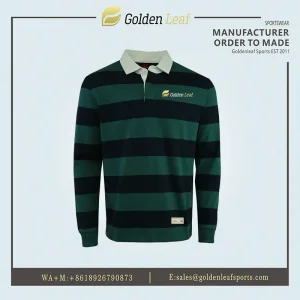
Modern sublimated long sleeve rugby shirts feature specialized collar designs: the traditional woven twill collar with a concealed rubber-button placket (to prevent facial scratches during scrums), or the contemporary low-profile loop collar made from flexible poly-spandex. Chinese factories utilize die-cut rubber buttons designed to flex under extreme tension rather than shatter.
Automation, Smart Textiles, and Green Supply Chain Transition in Chinese Manufacturing
Environmental regulations and consumer expectations in Europe, North America, and Australasia have pushed eco-textiles to the forefront. Premier Chinese suppliers now offer Global Recycled Standard (GRS) certified post-consumer recycled polyester yarns milled from ocean plastic bottles. These rPET fabrics match virgin polyester in tensile strength and ink absorption while reducing carbon emissions by up to 45% per garment.
Manual fabric cutting often introduces dimensional errors of 5-10mm, causing graphic distortion when sewing long sleeves to shoulder panels. Advanced Chinese suppliers employ automated CNC laser cutters equipped with high-resolution overhead cameras. These systems detect sublimated contour outlines in real time, automatically compensating for stretch during the cutting phase to achieve sub-millimeter precision.
Next-generation sublimated long sleeve rugby shirts are increasingly embedded with washable, flexible RFID or NFC tags woven into the neck label or side seam. This enables professional clubs and university sports departments to automate laundry tracking, manage team kit distribution, prevent retail counterfeiting, and provide fans with interactive digital authentication via mobile device scanning.
Customizing Technical Specifications for International Climate Zones, Leagues, and Brand Niche Markets
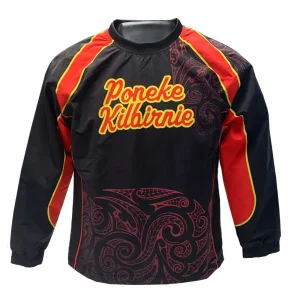
Scenario: High-impact winter leagues, indigenous art team kits, and school carnivals.
Technical Requirement: Heavyweight 280-300 GSM interlock fabric with high UV protective coatings (UPF 50+ rating). Precision vector sublimation capabilities capable of reproducing complex Aboriginal and Maori artwork with crisp line clarity and high color saturation. Must feature reinforced plackets to withstand rigorous tackle drills.
Scenario: Traditional amateur club leagues, collegiate derby matches, and winter training gear.
Technical Requirement: Long sleeve constructions with internal brushed fleece or thermal fleece-backing (260 GSM poly-fleece). Traditional woven cotton-feel polyester collars, hidden rubber buttons, and moisture-wicking properties designed for wet, cold playing fields. High resistance to soil staining and frequent industrial laundering.
Scenario: High school rugby programs, university club championships, and boutique private-label streetwear brands.
Technical Requirement: Dual-purpose specs. Athletic kits demand 4-way stretch poly-spandex (250 GSM) with tight athletic compression fits. Lifestyle fashion orders require relaxed vintage cuts, heavy twill collars, embroidered crest patches over sublimated base patterns, custom branded woven neck labels, and individual retail polybagging.
A B2B Roadmap from Initial Artwork Vectorization to International Customs Clearance
For enterprise purchasing directors, athletic brand managers, and sportswear distributors, procuring custom sublimated long sleeve rugby shirts from China requires strict quality control assurance at every production stage. Reliable suppliers implement an end-to-end Acceptable Quality Limit (AQL 1.5/2.5) framework:
Every artwork profile is processed through specialized Raster Image Processor (RIP) software to convert RGB vectors into precise CMYK dye formulas. Sample swatches are printed onto actual polyester base fabrics and checked against physical Pantone TPX/TCX color books under standardized D65 light boxes, guaranteeing 98%+ color match accuracy prior to bulk runs.
During the cut-and-sew phase, in-line QA inspectors examine seam elasticity, collar flatness, and sleeve alignment. Every 50th jersey undergoes a pneumatic pull-test to ensure seams withstand 1,200 kPa bursting pressure without thread popping. Cuffs are checked for elastane recovery to ensure tight fitting around wrists.
Finished long sleeve shirts undergo 100% thread trimming, steam pressing, and size sorting. Garments are individual polybagged with barcode stickers, custom hangtags, and moisture-absorbing silica packets. Master cartons are constructed from 5-ply double-corrugated cardboard reinforced with corner protectors for safe ocean or air freight delivery.
Direct Technical Answers from Expert Apparel Technicians and Supply Chain Directors
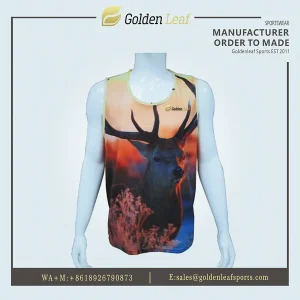
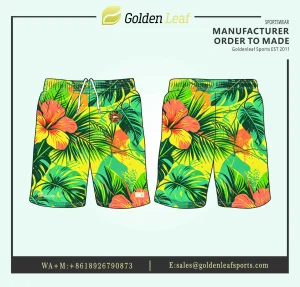
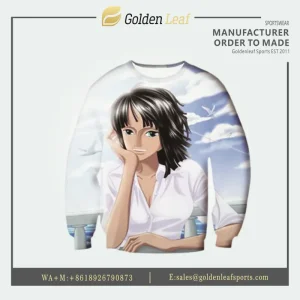
Complete your athletic catalog with complementary custom sublimation apparel manufactured to identical high-tensile engineering standards.