GoldenLeaf Sports14+ Years Teamwear Manufacturer · Shenzhen, China
GoldenLeaf Sports14+ Years Teamwear Manufacturer · Shenzhen, China
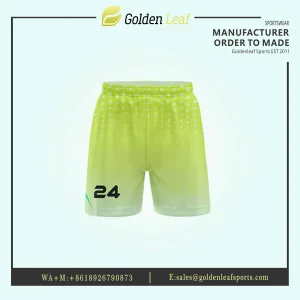
The global athletic apparel market has transitioned from commoditized bulk sewing toward high-precision, engineering-driven textile fabrication. Within this macro environment, custom basketball shorts suppliers and factories occupy a vital strategic intersection. No longer defined merely by simple elastic waistbands and single-layer mesh cutouts, modern basketball shorts represent a convergence of biomechanical engineering, advanced polymer material science, and high-definition digital dye-sublimation.
Driven by shifting consumer behaviors—spanning professional FIBA/NCAA athletic programs, street-level basketball culture, and the explosive growth of direct-to-consumer (DTC) private label athleisure brands—manufacturers must balance high-tensile durability with lightweight thermo-regulation. Modern production hubs, particularly localized clusters in Shenzhen and Guangdong, have re-engineered supply chains to offer scalable OEM (Original Equipment Manufacturing) and ODM (Original Design Manufacturing) frameworks capable of handling complex graphic customization, specialized GSM (Grams per Square Meter) fabric weights, and strict compliance metrics.
Superior custom basketball shorts depend fundamentally on raw textile selection. Leading suppliers utilize specialized yarn counts (such as 75D/144F micro-polyester) woven into structured matrices designed for moisture capillary action, breathability, and tactile comfort.
Utilizing open-hole knit geometry, bird-eye mesh (145 GSM to 180 GSM) facilitates rapid air permeability (CFM values > 180). For luxury streetwear brands, dual-layer micro-mesh (220–280 GSM) provides substantial structure without trapping body heat during intensive court activity.
Incorporating 8% to 15% elastane (Spandex) into high-tenacity polyester knits unlocks 360-degree multidirectional elasticity. This mechanical stretch is vital for modern athletic cuts, allowing aggressive lateral movement and jump mechanics without hem displacement or seam tearing.
Chemical finishings applied at the yarn dyeing stage impart hydrophilic properties. Sweat is pulled rapidly along the synthetic fibers to the outer garment surface, accelerating evaporation rates by up to 40% compared to standard untreated cotton blends.
Achieving tier-1 apparel consistency demands precise process control across every fabrication phase. Professional factories operate under ISO 9001 guidelines, executing an 8-stage technical workflow from vector design verification to final automated packaging.
Digital pattern makers construct graded CAD templates spanning Youth 6Y through Adult 5XL. Color profiles are converted to CMYK/Pantone Matching System (PMS) swatches to ensure absolute color fidelity across different fabric rolls.
Utilizing high-end digital sublimators (e.g., Epson, Mimaki) and Eco-friendly Italian water-based inks (Kiian/Inktec), patterns are heat-transferred at 200°C–215°C under high pneumatic pressure. The dye gaseous state fuses directly into the polyester polymer matrix, preventing cracking, peeling, or fading over extended wash cycles.
Automated camera-guided optical laser cutters scan print registration marks, cutting fabric panels with a tolerance of less than ±0.5mm. This eliminates edge fraying and ensures pattern continuity across side seams and pocket inserts.
Garment assembly incorporates 4-needle 6-thread flatlock seams, heavy-duty 500D polyester thread for crotch gussets, and multi-needle elastic waistbands. Integrated drawcords, custom metal aglets, and hidden zippered pockets are inserted under strict seam-tension settings.
Custom basketball shorts suppliers must adapt product specifications to match distinct operational environments, compliance standards, and commercial pricing models across global regions.
Requirements: Strict adherence to jersey/shorts dimension regulations, anti-friction flatlock seam construction, high-abrasion resistance, and rapid player number/name variable customization.
Solution: Light 150-160 GSM 4-way stretch poly-spandex with mesh side ventilation panels. Double-stitched crotch reinforcement capable of withstanding >250 N tensile pull force.
Requirements: Heavyweight luxury feel, high fashion aesthetics, complex embellishments (e.g., puff printing, chenille embroidery patches, custom jacquard elastic bands, heavy metal drawcord aglets).
Solution: 240–300 GSM dual-layer heavy polyester mesh, relaxed boxy cut, custom woven neck/waist labels, and customized branded polybag packaging.
Requirements: Cost optimization, rapid turnaround times (10–14 days), high stain resistance, non-toxic eco-inks, and wide size range availability (Youth 6Y to Adult 3XL).
Solution: Standard 145 GSM bird-eye polyester, high-volume digital sublimation, low minimum order quantities (MOQ starting at 10 pcs), and direct dropshipping options.
Navigating international trade barriers and market-specific safety mandates requires suppliers to maintain stringent quality management systems and transparent raw material documentation.
Leading OEM factories implement a multi-gate inspection routine: Raw Material Inspection (AQL 1.5 for dye uniformity and tensile strength), In-Line Stitching Audits (checking thread tension and needle gauge), Pre-Sublimation Color-Match Audits using X-Rite Spectrophotometers, and 100% Final Garment Inspection prior to polybag sealing.
The custom athletic wear manufacturing sector is undergoing rapid technological transformation. Forward-thinking suppliers are investing in digital twin technologies, automated production lines, and closed-loop circular textile models.
Integration of generative AI tools and 3D CAD visualization platforms allows client buyers to render real-time digital samples, reducing physical sampling cycles from weeks to under 24 hours.
Advanced waterless dye-sublimation and direct-to-fabric digital pigment technologies dramatically reduce wastewater consumption, aligning with global Net-Zero carbon mandates and ESG investment requirements.
Next-generation athletic shorts will feature conductive yarn structures capable of measuring player biometric data—including muscular exertion, heart rate, and thermal regulation—without adding bulky external hardware.
Answers to critical engineering, purchasing, and supply chain queries commonly raised by international procurement teams, brand managers, and sports outfitters.