GoldenLeaf Sports14+ Years Teamwear Manufacturer · Shenzhen, China
GoldenLeaf Sports14+ Years Teamwear Manufacturer · Shenzhen, China
Explore our top-tier custom manufactured teamwear engineered for extreme physical impacts and optimal breathability.
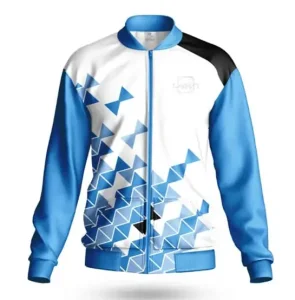
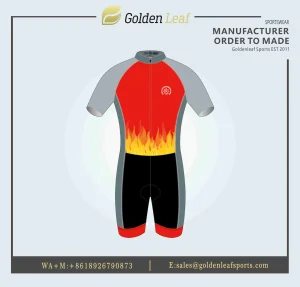
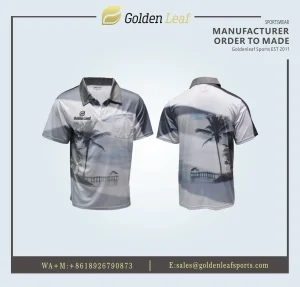
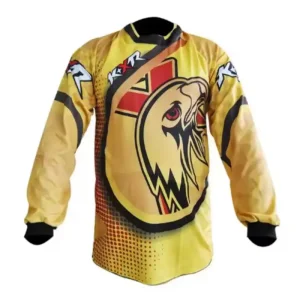
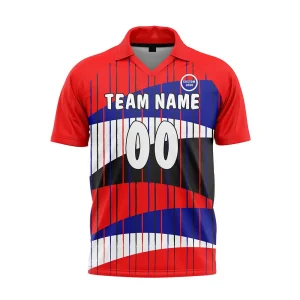
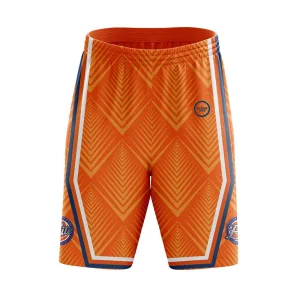
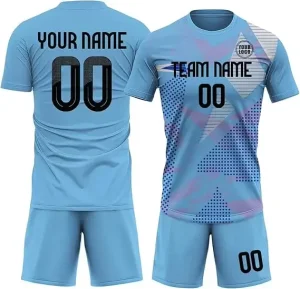
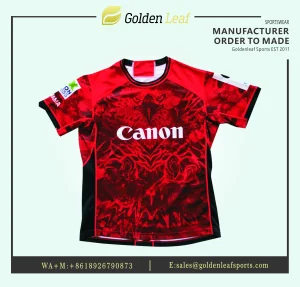
An authoritative technical analysis for sports apparel brand managers, international distributors, and elite league equipment procurement officers.
Modern contact sports demand apparel that balances extreme mechanical elasticity with passive thermal management. Standard screen-printed heavy cotton rugby shirts lack moisture transportation kinetics and suffer from seam failure under high-shear tackle force. High-density sublimation printing on engineered polymer substrates eliminates peeling, cracking, and weight gain from sweat absorption.
The global rugby apparel market has undergone a paradigm shift. Traditional 100% heavy cotton knit jerseys, which absorb up to 27% of their weight in moisture and become heavy during competitive play, have been virtually phased out of professional leagues. Modern teamwear leverages hydrophobic polyester filaments combined with spandex, providing low water retention (<1%) and rapid capillary evaporation.
Tier-1 markets including the UK (Gallagher Premiership), Australia (NRL/Super Rugby), New Zealand, France (Top 14), and South Africa dominate bulk contract volumes. Simultaneously, rapid growth across North American collegiate circuits (MLR in the USA) and Asian sevens tournaments has surged demand for localized customization, quick re-order turnarounds, and low-MOQ options.
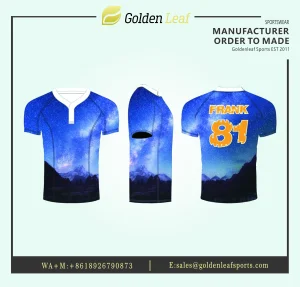
Legacy apparel manufacturing required massive screen-printing setup fees and physical inventories. Modern custom apparel factories operate fully digitalized sublimation workflows. Computer-aided design (CAD) patterns integrate direct vector graphics onto heat-transfer paper, allowing simultaneous printing of varied player names, squad numbers, and sponsor logos without added tooling cost.
Comparing textile construction methodologies for high-impact rugby gear.
| Performance Metric | Legacy Cotton Twill | Standard 100% Poly Mesh | GoldenLeaf Pro 4-Way Stretch Poly-Spandex |
|---|---|---|---|
| Fabric Weight (GSM) | 300 - 350 GSM | 160 - 180 GSM | 280 - 320 GSM |
| Tensile Strength (N) | ~450 N (Low Tear Res.) | ~650 N (Medium Tear Res.) | > 1,150 N (Reinforced Cross-Weave) |
| Moisture Absorption Rate | High (Retains Water/Sweat) | Moderate (Surface Wicking) | Zero Hydrophilic Retention (Micro-Pore Evaporation) |
| Elastane Extension | 0% (Rigid Frame) | 2% - 4% (2-Way Mechanical Stretch) | 12% - 15% (4-Way Multidirectional Stretch) |
| Seam Construction | Standard Single Stitch | Double Needle Overlock | 6-Thread Flatlock Reinforced Bar-Tack Seams |
| Color Fastness (Sublimation) | Grade 2-3 (Fades/Bleeds) | Grade 3-4 (Standard Ink) | Grade 4.5+ (Eco-Friendly Italian Inks) |
Our engineered polyester fabrics utilize a dual-surface structure. The inner face resting against the athlete’s skin features microscopic denier channels that pull moisture away via capillary action. The outer face spreads water molecules across a wider surface area to accelerate evaporation. This active cooling mechanism maintains lower core body temperatures during 80 minutes of intense play.
Modern professional rugby shirts feature tight, athletic ergonomic cuts designed to minimize opponents' ability to grab fabric during tackles. Optional internal silicon dot prints around the chest and hem prevent jersey ride-up and enhance ball handling security in wet, slippery conditions.
Tailored textile construction options formulated for regional climate conditions and tournament formats.
Regions: Pacific Islands, SE Asia, Queensland AU.
Solution: Ultra-breathable 160-180 GSM open bird-eye mesh panels under armpits and side seams, offering airflow while maintaining 280 GSM main body tearing resistance.
Regions: UK, Ireland, France, New Zealand.
Solution: Heavyweight 300 GSM brushed fleece-back thermal poly-spandex options with water-repellent (DWR) coating for training outer layers and winter match kits.
Scenarios: High-speed 7-a-side matches.
Solution: Lightweight 220 GSM 4-way stretch construction focusing on zero wind resistance, reduced weight, and maximum mobility for sprinting backs.
Focus: Budget durability & multi-size growth.
Solution: Reinforced flatlock seam stitching with stain-resistant sublimation treatment to ensure uniforms endure multiple seasons of washing and playing.
Unlike traditional mills requiring 500+ units per style, GoldenLeaf Sports offers a flexible Minimum Order Quantity starting at just 10 pieces per design. Because we print vector artwork digitally onto panels prior to cut-and-sew assembly, squad rosters with distinct player names, numbers, and sizes can be executed seamlessly in a single batch.
We provide full white-label and private label packaging packages: customized woven collar labels, heat-transfer inner neck sizing tags, customized hangtags with barcode stickers, and custom printed eco-friendly polybags ready for direct retail distribution.
Meeting global environmental directives (GRS Certified), we offer options for 100% Recycled Polyester (rPET) woven from post-consumer plastic bottles. This recycled yarn maintains the exact tensile strength, breathability, and sublimation ink absorption as virgin polyester.
Elite professional rugby clubs utilize real-time biometric tracking to monitor player velocity, impact G-force, and heart rate metrics. Future sublimated rugby jerseys feature integrated neoprene pockets positioned between the shoulder blades. These pockets are seamless and reinforced to prevent chaffing during collision.
Environmental regulations are driving sublimation ink chemistry toward waterless dye diffusion. Modern Japanese and Italian imported sublimation inks eliminate volatile organic compounds (VOCs) while increasing UV resistance (preventing color degradation under intense sun exposure during long match days).
Established in 2011, operating a 3,000 m² state-of-the-art facility in Longgang District, Shenzhen.
Using advanced raster image processor (RIP) software calibrated to official Pantone Matching System (PMS) swatches, we guarantee 99.2% color fidelity across re-orders year after year.
Printed sublimation rolls are cut using high-precision optical laser machinery. Registration sensors read design boundaries to cut fabric panels with millimeter accuracy, ensuring side seams align flawlessly.
Our 5 dedicated full-time QA/QC inspectors examine garments across 5 touchpoints: Paper Transfer Verification, Cut Panel Alignment, In-Line Stitching Integrity, Finished Garment Dimensions, and Packing Sorting.
Detailed answers regarding technical specifications, custom manufacturing, and ordering logistics.
Discover our comprehensive range of custom athletic apparel and matching team accessories.