GoldenLeaf Sports14+ Years Teamwear Manufacturer · Shenzhen, China
GoldenLeaf Sports14+ Years Teamwear Manufacturer · Shenzhen, China
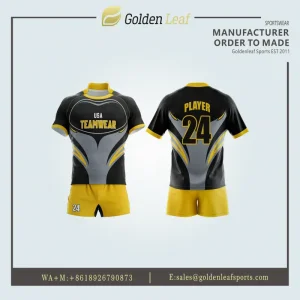
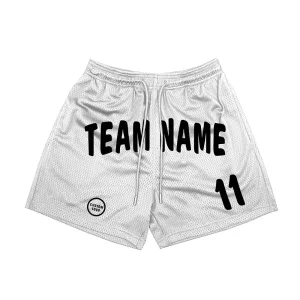
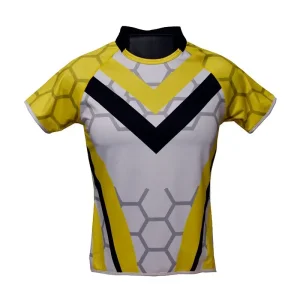
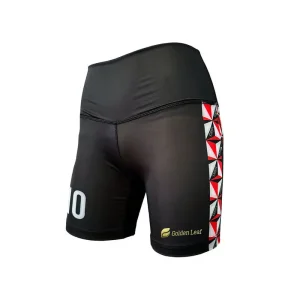
Explore our top-tier sublimation and OEM manufacturing configurations built under rigorous international textile testing benchmarks.
Understanding the historical trajectory of football apparel manufacturing reveals a transition from localized heavy-cotton craftsmanship to globalized, sensor-integrated high-performance polymer textiles.
The historical transformation of football equipment—spanning both association soccer and gridiron football—is fundamentally an engineering narrative about material kinetics, player thermal regulation, and structural reinforcement. In the late 19th and early 20th centuries, football kits were characterized by dense, unbleached woolens and unmercerized twill weaves. While resilient against abrasive surface contact, these garments held up to three times their weight in precipitation, radically diminishing player biomechanics and elevating muscular fatigue.
The industrial inflection point took hold across the mid-1970s with the broader adoption of non-polar synthetic yarn technologies, primarily synthetic polyamides and linear polyethylene terephthalate (PET). This paved the way for advanced moisture management systems, introducing capillary wicking mechanisms where hydrophobic polymer chains displace perspiration away from the athlete's dermis to an exterior evaporation boundary layer. Concurrently, industrial pad and helmet design moved from vulcanized molded leather to suspension-web helmets, followed by high-density expanded polypropylene (EPP) and injection-molded polycarbonate shells capable of dissipating dynamic kinematic shocks.
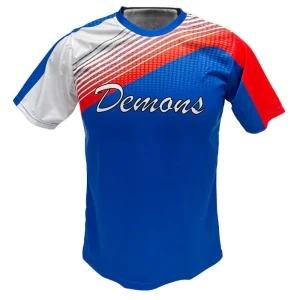
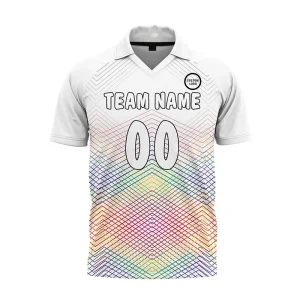
Unlike conventional screen printing or plastisol heat transfers which obstruct fabric micropores and induce peeling over repeated thermal wash cycles, gas-phase dye sublimation permanently infuses eco-friendly inks directly into the polymer matrix at 200°C+, leaving zero tactile residue and retaining 100% fabric breathability.
Modern wholesale teamwear demands rigorous multi-regional block grading. From collegiate youth blocks up to 5XL extended athlete fits, our automated CAD patterns and laser-guided cutting stations account for specific regional pad ergonomics, hyper-extended arm movements, and targeted anti-tear gusset integrations.
Global athletic leagues operate under compressional turnaround constraints. Our factory architecture provides high Information Gain and full agility: handling agile 10-piece prototype sprints up to 50,000-unit bulk institutional distributions with synchronous QA sign-offs at cutting, sewing, and final packaging.
Precision engineering meets multi-jurisdictional conformity to ensure uncompromised safety, performance, and legal readiness for global distributors.
Garments built for the US and Canadian scholastic athletic markets adhere directly to NOCSAE structural protocols for reinforced tackle uniforms, CPSIA lead and phthalate restrictions on team embellishments, and strict NFHS uniform jersey coloration rules regarding number contrast visibility.
Export runs heading to the European Union strictly fulfill OEKO-TEX Standard 100 Class I & II requirements, verifying non-toxicity in all raw polyester yarn bases, along with complete conformity to EU REACH directives preventing hazardous azo dyes and heavy-metal chemicals in athletic gear.
In Australian, New Zealand, and UK rugby circuits, gear must withstand dynamic tensile force loads exceeding 1,200 Newtons. We apply twin-needle flatlock construction, reinforced collar twills, and 88/12 polyester-elastane interlocks engineered against high-velocity collar tackles and ground scuffs.
How smart textiles, biopolymer fibers, and closed-loop manufacturing pipelines are reshaping the B2B sportswear frontier.
Widespread adoption of 145–180 GSM micro-filament moisture-wicking polymers with computerized raster image processor (RIP) Pantone fidelity matching.
Mass-scale adoption of post-consumer plastic bottle-recycled yarns (rPET) combined with fluorine-free durable water-repellent (DWR) surface coatings.
Direct weaving of conductive silver-plated microfibers capable of capturing heart-rate variability, muscular hydration status, and core thermal index without external straps.
Ultra-thin impact padding using shear-thickening fluid polymers (D3O molecular matrices) printed directly onto internal jersey liners for seamless collision dampening.
Factory-level transparency addressing low-MOQ capabilities, sublimation physics, and international trade compliance.
Browse complementary uniform systems, tracksuits, and athletic wear engineered on the same robust OEM infrastructure.